This is the first article in our introduction to compute markets, a series explaining how computing capacity is bought, sold, and financed. We begin with the primary market, where providers sell capacity directly to customers, and the three common ways those transactions are structured: reserved, on-demand, and spot.
—
Congratulations! You’ve just received a quote for 1,024 NVIDIA B300s. Soon, you could be renting the chips to customers training AI models, serving inference, and more.
Unfortunately, buying the B300s requires more money than you have on hand. You’ll need a loan, and the lender wants to know how you’ll earn enough from renting the GPUs to cover operating costs and repay your principal plus interest. Once the cluster is running, those bills will come due whether customers are using the GPUs or not. Before committing to the purchase, you need a plan for who will rent your capacity, at what price, and for how long.
On the “primary” market, where compute is sold directly from data centers to compute consumers, there are three types of distribution:
Reservations
To begin, you can sell via reservation, where a customer commits to capacity for an agreed period of time. In fact, a long-term reservation could help secure the financing needed to purchase and deploy your GPUs.
Originally, when you approached the lender, you were equipped with projections of what customers might pay to rent your B300s, but no contracts committing them to do so. The lender responds: if rental prices fall or the GPUs sit idle, how can we be confident the loan would be repaid?
To credit investors, companies like yours—with uncertain cash flows—are considered “junk.” In nicer words, your company is bucketed as “high-yield” because you’re more likely to default. As the name suggests, this means that you’ll need to pay much higher interest on your loans, if you’re able to secure a loan at all. In this case, the rate your lender demanded made financing the GPUs too expensive for the project to work.
What do you do?
To get better financing terms, you need to give the lender more confidence you will generate enough revenue to repay the loan. So, you approach an old friend managing compute at a hyperscaler, and you give them a proposal. The hyperscaler—a creditworthy offtaker with a deep balance sheet—commits to paying for 640 of your B300s for five years, and in return, you commit to making those GPUs available for its use 99.9% of the time once the cluster is delivered and accepted. The hyperscaler agrees, and the promise is set out in a service-level agreement, or SLA. If your downtime exceeds that allowance, you’ll owe the hyperscaler service credits, or even give it the right to terminate the contract.
In this case, the hyperscaler signs a “take-or-pay” contract, agreeing to pay $4 per GPU-hour for all 640 B300s throughout the five-year term, whether it uses them or not. It plans to train models around the clock, so it expects to use most of the hours it’s buying. When it doesn’t need the full cluster for training, it can put the remaining capacity toward research experiments or serving models through inference.
With the hyperscaler as your “anchor tenant,” you return to the lender. This time, you bring a contract committing the customer to $22,425,600 a year in payments ($4 per GPU-hour across 640 GPUs, 24 hours a day, 365 days a year). You still need to deliver the cluster, meet your service commitments, and manage operating costs but—provided you perform and the hyperscaler pays—your revenue is now partially immunized to the uncertain price of GPU-hours.
Hence, the lender is now willing to give you a delayed draw term loan at SOFR + 5%, which you use to buy your 1,024 GPUs, with the GPUs themselves serving as collateral. Mission accomplished.
By selling through reservation, you are effectively sacrificing the potential upside on 640 of your GPUs if B300 rates rise, because you’ve already locked in a price. On the other hand, you now have the necessary customer revenue to finance the cluster.
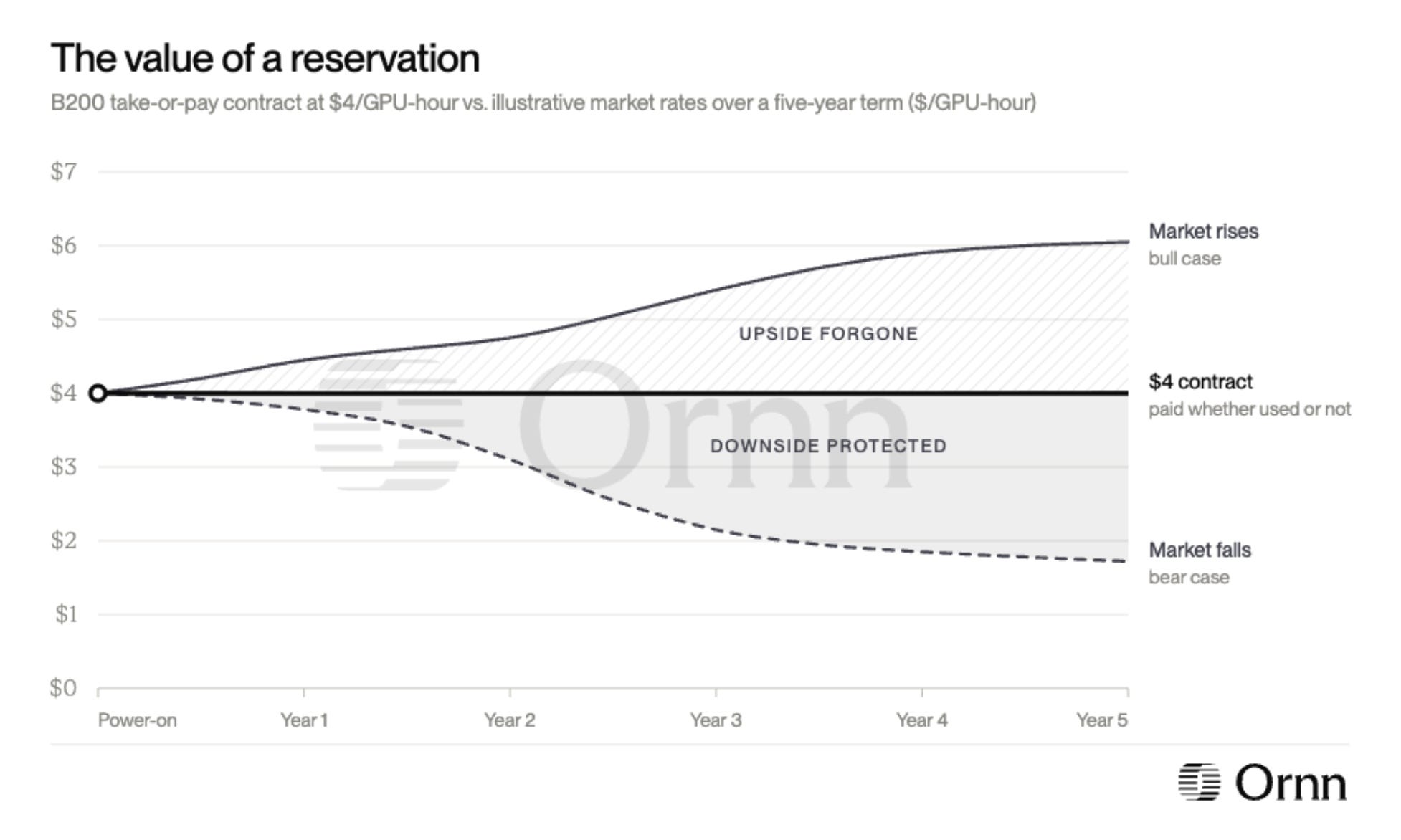
We’ve used a five-year reservation to show how a customer contract can help finance your cluster, but reservations can also last a month, a year, or another agreed period. Generally, the longer a customer commits, the lower the hourly rate it can negotiate. You gain more certainty about future revenue, while the customer gets a discount for agreeing to keep paying even if its compute demand changes or rental prices fall.
On-Demand
With 640 of your 1,024 B300s reserved by the hyperscaler and financing secured, you still have 384 GPUs available to rent. What do you do with them?
You could find another long-term tenant, but you’ve already secured the financing needed to deploy the cluster, and you’re bullish on B300 rental rates. Keeping some capacity uncommitted would let you charge higher rates if prices rise over the next few years.
So you decide to sell some compute capacity “on-demand.” Here, customers rent your available GPUs without committing to a fixed term and release them when they’re finished. Rates are quoted per GPU-hour, and charges are often calculated by the second or minute. You charge a higher hourly rate for on-demand rentals than for reservations in exchange for this immediate access and flexibility.
Who are the buyers of on-demand? Any company with variable token usage.
A reinforcement learning provider, for instance, helps AI companies adapt open-source models to specific workloads. Customers pay for individual training runs or projects, without necessarily committing to ongoing work. If the provider reserves GPUs for several years, it will have to keep paying for them long after those projects end, unless it can find enough new business to fill the gap.
Consider one of its customers, a legal AI startup adapting a model to review contracts. The provider rents two eight-GPU B300 servers to run several training experiments in parallel. Once the team has compared the results and narrowed its approach, it continues on one server and releases the other. Once the project ends, it can release the remaining GPUs too.
Renting on-demand lets the provider adjust its compute spending as the revenue supporting that spending changes. It pays a higher price for each GPU-hour but can stop buying hours it no longer needs. It can also take on new customers without first funding a larger fleet or committing to years of rental payments on the strength of their forecasts. Hence, for this reinforcement learning provider—and many other AI companies—the flexibility of on-demand is worth the higher cost.
As the reinforcement learning provider builds a steadier pipeline of projects, it may rent enough GPUs via reservations to cover the demand it can reliably expect and rent additional capacity on-demand during busier periods. Electricity retailers take a similar approach, securing part of their expected demand through long-term contracts and buying the rest at short-term prices. Combining the two lets suppliers optimize their balance sheet risk and flexibility.
Spot
After narrowing its training experiments, the reinforcement learning provider releases one of your eight-GPU B300 servers. You offer them to other customers on-demand, but nobody is renting them at your current rate. For now, they sit idle.
An academic researcher happily offers to rent those GPUs, but has a limited budget. You offer a deal at, say, half your on-demand rate. In exchange, the researcher agrees that you can stop its workload and reclaim the GPUs at short notice if another customer needs them. This is spot compute; the rental is cheaper because it is “interruptible.”
A few days later, an inference provider wants to rent eight B300s on demand. You notify the researcher, stop its workload, and reallocate the GPUs to the new customer. The researcher can resume when spot capacity becomes available again.
For you, spot earns revenue during hours that would otherwise go unsold, while preserving the ability to reclaim the machines for more valuable on-demand customers.
What Ornn’s indices measure
As this article shows, GPU pricing differs across reserved, on-demand, and spot arrangements, even when the hardware is the same. The Ornn Compute Price Index (OCPI) measures specifically on-demand GPU rental prices in USD per GPU-hour, using only executed transactions. Reserved and interruptible spot rentals are excluded. The OCPI H100 and B200 benchmarks underpin the corresponding monthly cash-settled GPU compute futures contracts on ICE Futures U.S.
When customers become sellers
So far, you’ve sold access to your precious 1,024 B300s directly to customers. However, a year into its five-year reservation, the hyperscaler’s plans change. It no longer needs all 640 GPUs, yet remains committed to paying for them.
If its agreement permits, the hyperscaler decides to recover some of its cost by reselling access to the capacity it no longer needs. Another customer uses your GPUs, while the hyperscaler continues paying you under the original reservation.
That resale takes us into the secondary compute market, the subject of our next article.
Research: Daniel Chuang, Charlie Sheiner
GPU prices in this article
The latest Ornn Compute Price Index (OCPI): executed on-demand rental prices, per GPU-hour.
More research
- Utilization is King: The Buyer’s Side of Compute Certainty Tax
When a GPU reservation beats renting on demand, and why the timing of use matters as much as the amount.
- Will Anthropic Grow Into Its Compute Bill?
What Anthropic’s $895 billion in compute commitments imply about its growth trajectory.
- The Compute Certainty Tax
How much revenue GPU clouds give up to make their fleets financeable.