“If you’re off by only a year, you destroy yourselves,” Dario Amodei said of the stakes of buying compute, speaking on the Dwarkesh Patel podcast in February. Buy too much and the payments can bankrupt you, and buy too little and you risk falling behind. Anthropic’s long-awaited S-1, filed on October 26 and amended on November 2, now offers the clearest view of how the company has handled that trade-off, and of how much it has agreed to spend.
Across seven disclosed deals, Anthropic’s compute commitments come to $644 billion, but the amended filing puts its total committed spending, including its other arrangements, at about $895 billion. SpaceXAI will charge Anthropic about $37.2 billion a year once its capacity is fully delivered, more than half of Anthropic’s annualized Q3 revenue, and that is before Google, Amazon, Microsoft or Broadcom are paid anything. Working backward from these deals—acknowledging their differences in timing, cancellation rights and conditions for delivery—gives a reasonable estimate of how much revenue Anthropic will need in order to support the spending it has committed to.
So how much revenue does Anthropic need to generate to grow into its compute commitments? Let’s find out.
The revenue side
Over the past year and a half, Anthropic’s revenue has grown far faster than its compute expenses, which is a good place to start. In the second quarter of 2026, revenue rose 1,368% from a year earlier while compute and infrastructure expenses rose 300%, and as a result compute fell from 251% of revenue in the first quarter of 2025 to 48% in the second quarter of 2026. Q3 went the other way. Revenue rose to $17.0 billion, but compute expenses jumped to $9.9 billion, or 58% of revenue, and Anthropic swung from an operating profit of $974 million in the second quarter to an operating loss of $567 million. The filing attributes the loss mainly to $5.0 billion of short-term compute, which it says currently costs significantly more than compute bought under its multi-year contracts, and $2.0 billion of non-cash charges for its donation matching program.
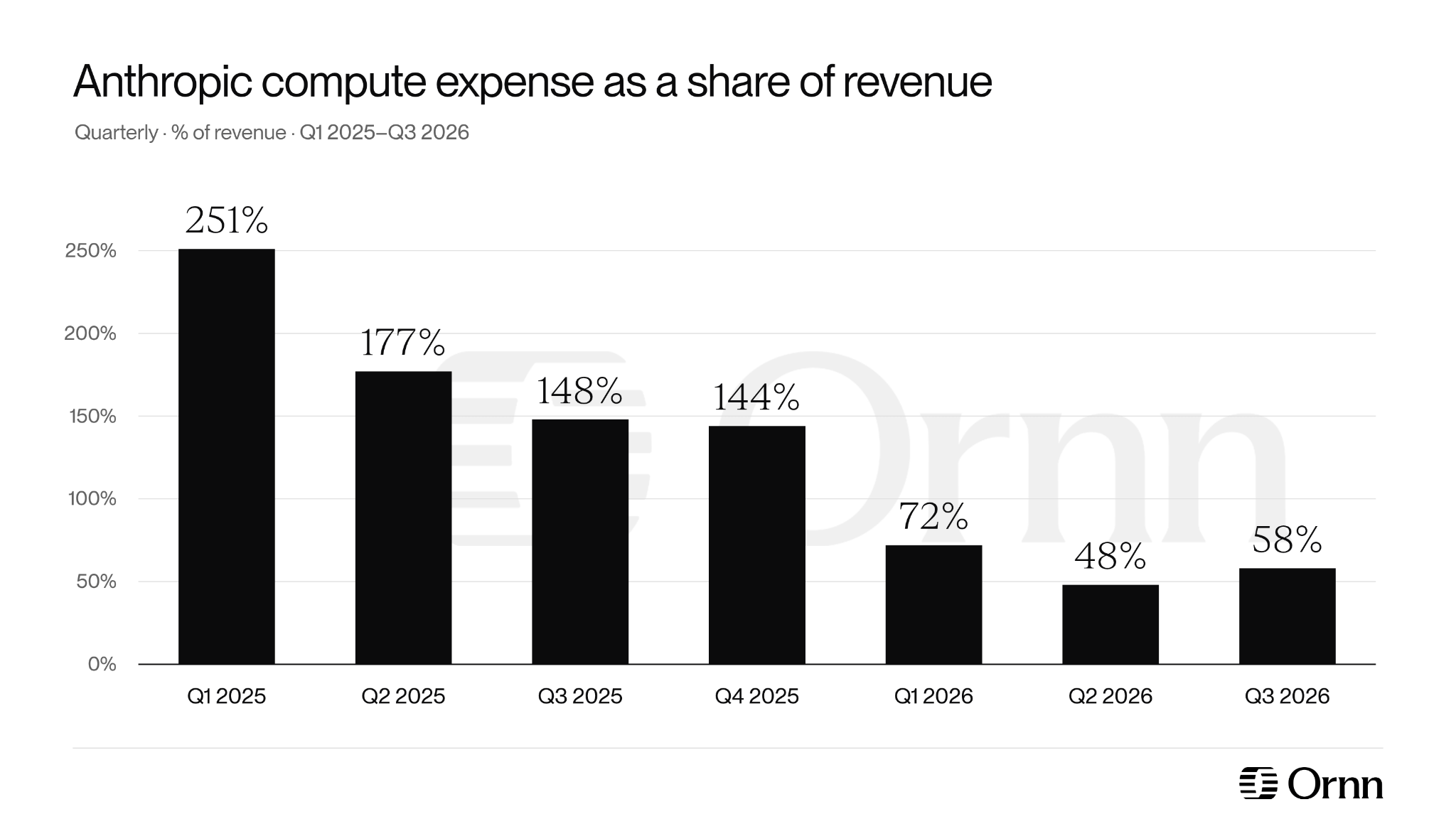
Source: Anthropic S-1 and amended S-1
That growth shows existing customers spending more and a fast-growing base of large accounts. Net revenue retention was about 900% as of September 30, and more than 11,900 customers paid Anthropic at least $100,000 over the trailing twelve months, up from more than 950 a year earlier. Keeping it going depends on staying at the frontier, since models released in the six months to September 30 accounted for more than 80% of third-quarter revenue.
Anthropic also spends far more on compute than it records as the cost of serving paying customers. In the first nine months of 2026 it reported $4.8 billion in cost of revenue against $18.8 billion in compute and infrastructure expenses, so even if every dollar of cost of revenue were compute, serving customers would account for less than 26% of the total. Most of the rest goes to model development, research and internal use, with some spent on giving people free access to Claude, although the filing does not break out the amounts. In other words, the company is buying capacity to earn revenue today and to build the models it expects to earn revenue from later.
Meanwhile, its customers are mostly free to change how much they buy. About 79% of revenue in the first nine months of 2026 came from consumption-based fees, and the filing notes that many customer contracts allow customers to reduce usage or terminate with limited or no notice. A growing number of enterprise customers do sign non-cancelable annual or multi-year contracts with minimum spending commitments, in exchange for a committed price list, but the filing does not say how much future spending those minimums cover.
Anthropic’s compute commitments
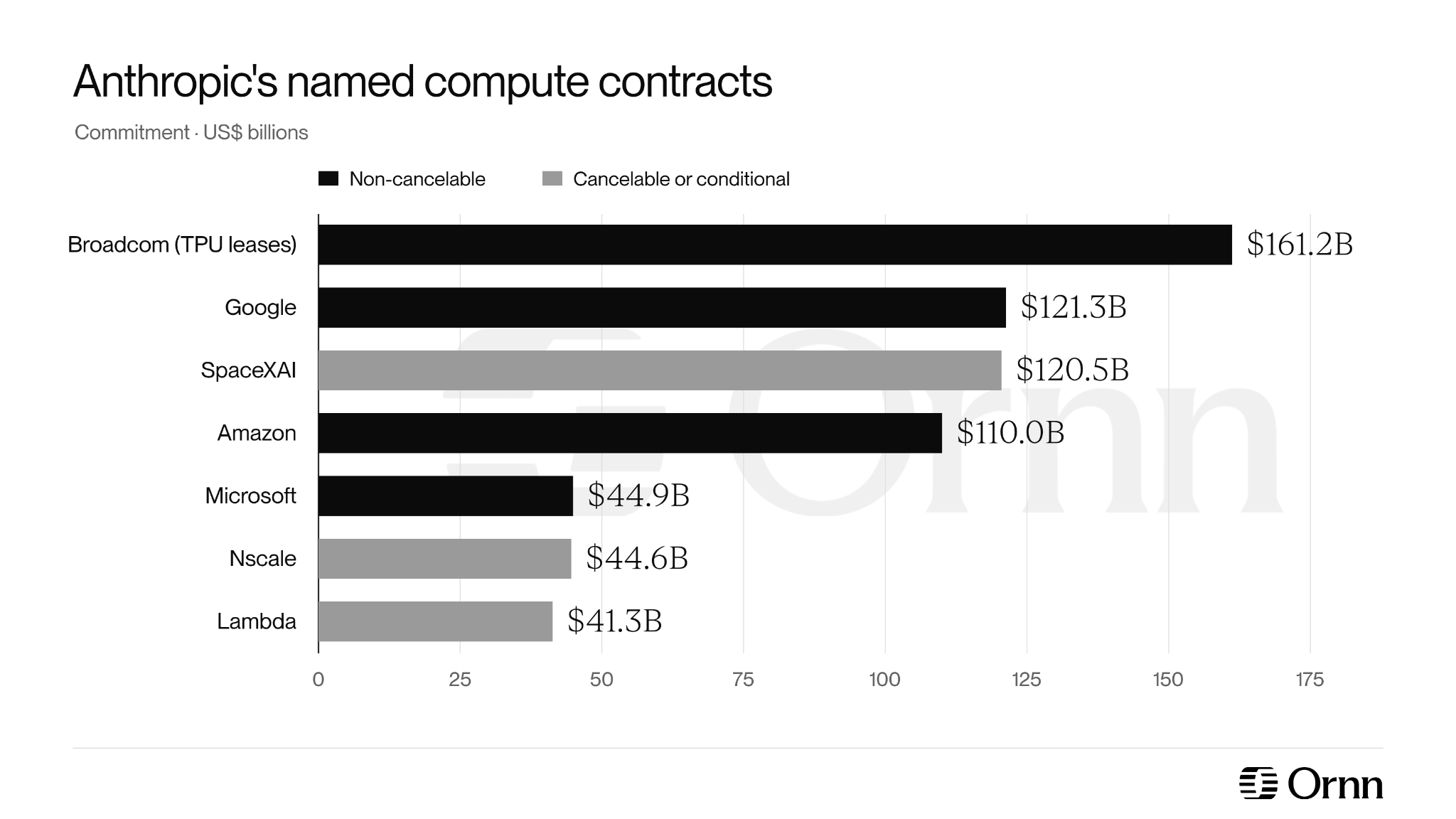
The seven named arrangements total $644 billion, though their payment obligations and exit provisions differ a great deal. Anthropic contracts most of its compute 12 to 18 months before delivery, generally under multi-year agreements, and manages it as a single pool spanning AWS Trainium, Google TPUs, NVIDIA GPUs and AMD GPUs.
The Google, Amazon and Microsoft agreements commit Anthropic to years of spending against revenue that its customers, for the most part, have not promised. Google requires at least $121.3 billion between April 2026 and July 2033 and Amazon at least $110 billion between May 2026 and April 2036, with true-up payments for any shortfall in usage. Microsoft adds at least $44.9 billion between November 2026 and June 2033, which can be canceled only for breach or for tranches not yet delivered.
Broadcom accounts for the largest single amount, $161.2 billion of rent, excluding interest, under five-year equipment leases that give Anthropic TPU-based capacity, part of which came online in 2026 with more due from 2027. Anthropic records these as finance leases, which puts the obligations on its balance sheet much as if it had borrowed to buy the equipment, and rent generally begins once the hardware is ready for service. Together, Broadcom, Google, Amazon and Microsoft account for $437.4 billion, roughly 68% of the named commitments, although Microsoft’s undelivered tranches keep a cancellation provision.
The remaining $206.4 billion covers NVIDIA capacity from SpaceXAI, Nscale and Lambda, and each of these contracts comes with conditions. SpaceXA’s agreement runs up to $120.5 billion, but either party can cancel on 90 days’ notice after initial periods ending in January and March 2027. Nscale’s agreement, worth up to $44.6 billion, requires it to use best efforts to obtain financing for the GPUs and supporting infrastructure, and $34.9 billion of Lambda’s $41.3 billion can be terminated if Lambda fails to secure a facility lease. Nscale and Lambda bill only as capacity is delivered.
The conditions on these three contracts cut in different directions. SpaceXAI’s cancellation right gives Anthropic a way to cut back if it has overestimated demand, whereas Nscale’s financing requirement and Lambda’s facility condition make delivery less certain without giving Anthropic the same freedom to walk away simply because it no longer needs the compute.
Source: Anthropic S-1 and amended S-1
The $644 billion also leaves out two potentially large additions. Anthropic expects to spend more than $20 billion with AMD from 2027 if it takes the full initial tranche, and it estimates another $125 billion to $150 billion for TPU capacity due between 2028 and 2031. Once short-term commitments and Anthropic’s other arrangements are counted as well, the amended filing puts total committed spending at about $895.4 billion, with about $447.5 billion due before the end of 2030 and the rest stretching as late as 2045.
How much growth is implied by Anthropic’s compute commitments?
Because Anthropic buys compute a year or more before it uses it, its commitments offer a way to estimate the revenue that could support them. One way is to ask how much revenue Anthropic would need for these contracts to cost it the same share of revenue that compute costs it now. In the first nine months of 2026, compute and infrastructure expenses came to 57% of revenue, and in Q2, when Anthropic turned its first operating profit, the figure was 48%. In Q3 it rose to 58%, and Anthropic lost money again.
The amended filing gives a rough schedule for those payments. About $69.8 billion of Anthropic’s commitments fall due in the 12 months after September 30, 2026, and $447.5 billion before the end of 2030, which leaves an average of roughly $116 billion a year from late 2027 through 2030. That is about 3x the $39.5 billion annual rate at which Anthropic was spending on compute in Q3. The seven contracts tell a similar story, since averaged over their terms they come to about $115 billion a year while they overlap, with SpaceXAI, at $37.2 billion a year, and Broadcom, at about $32 billion a year, accounting for more than half.
Translating those payments into revenue depends on how Anthropic splits its compute and what it earns on the part it sells. In the first nine months of 2026, using cost of revenue as a proxy for customer-serving compute puts it at roughly 26% of total compute spending and implies a gross margin of about 85%, or close to $6.90 of revenue per dollar of cost of revenue. The remaining compute spending, allocated to training, research, internal use and free access, brought in nothing directly. Taken together, every dollar of compute Anthropic recorded over those nine months supported about $1.77 of revenue.
At today’s ratio of compute spending to revenue, Anthropic would need to become a roughly $200 billion-a-year business to support its average annual compute commitments from late 2027 through 2030. That is about three times its Q3 annualized revenue of $67.8 billion. The nearer-term hurdle is substantial too, as supporting the $69.8 billion due over the next 12 months on the same basis would require about $123 billion of revenue over that period, roughly 80% above its Q3 annualized rate.
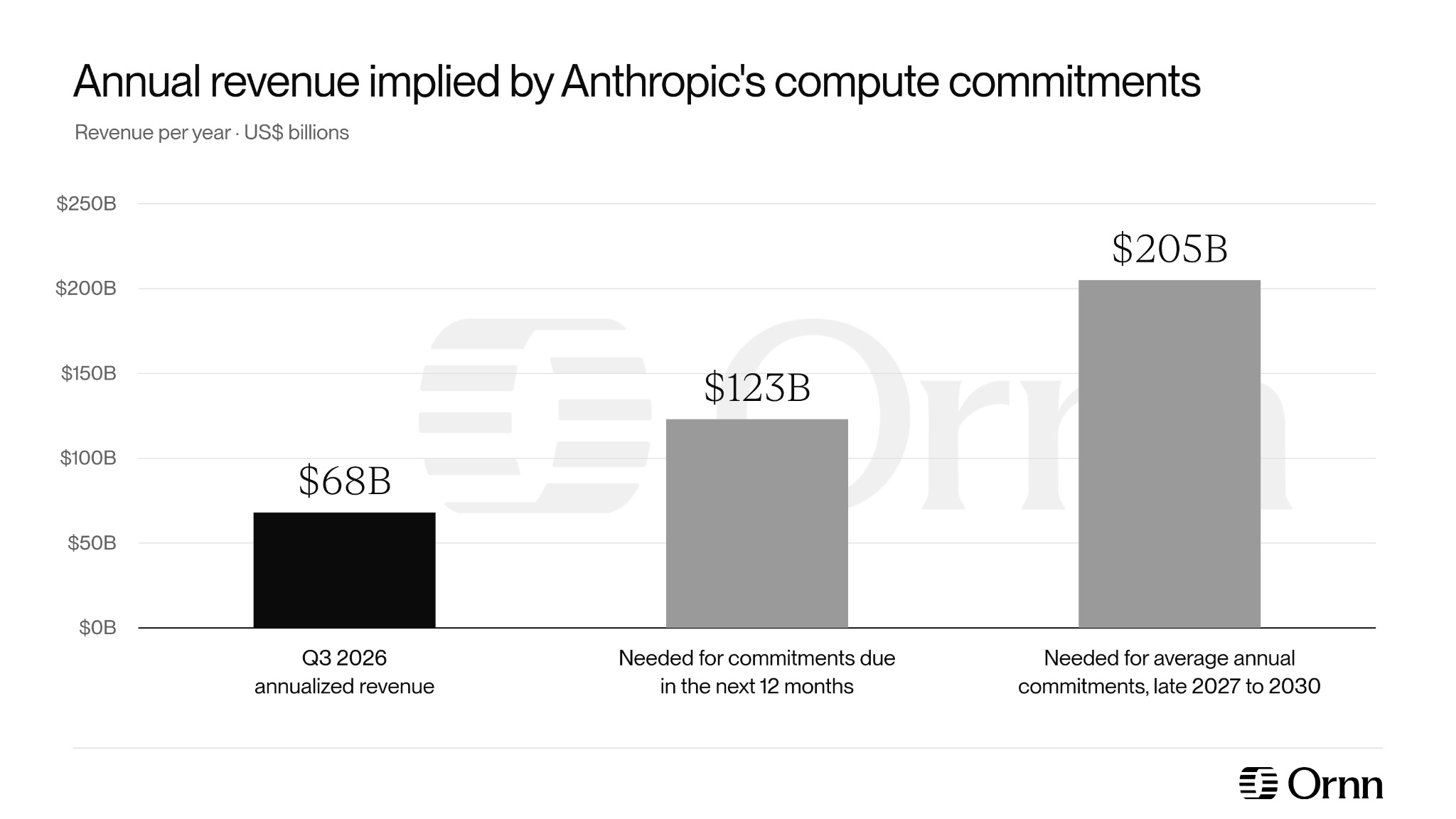
Source: Anthropic S-1 and amended S-1
The growth implied by these commitments is, admittedly, far slower than Anthropic’s recent growth trajectory. Q3 revenue was more than 12 times its level a year earlier. Amodei framed the risk in much the same terms on the podcast, saying “If I’m just off by a year in that rate of growth, or if the growth rate is 5x a year instead of 10x a year, then you go bankrupt.” The disclosed commitments suggest room for growth to slow considerably, provided each dollar of compute continues to support roughly as much revenue as it does today.
The estimate does, however, depend on Anthropic maintaining healthy margins. The filing’s cost of revenue implies a gross margin of about 40% for 2025, before rising to about 85% in the first nine months of 2026, and management expects operating margins to compress in periods when large blocks of new capacity come online. If the margin on serving customers fell to 60% while about a quarter of compute still went to paying customers, compute would cost roughly one and a half times revenue. To keep compute at its current share of revenue on those margins, Anthropic would have to devote about 70% of its capacity to paying customers and leave only about 30% for the research and model development behind the newer models that now produce most of its revenue.
What if Anthropic undershoots growth targets?
If revenue lags the commitments, the gap has to be covered from cash and financing, and the cushion is smaller than Anthropic’s large balance might suggest. Anthropic held $131.8 billion of cash and short-term investments at the end of September, before any proceeds from the IPO, and the $69.8 billion of commitments due over the following 12 months alone would use up more than half of it.
Anthropic’s suppliers have committed another $82 billion of financing, made up of $77 billion of note facilities from Google, Amazon and Broadcom and up to $5 billion of equity investment from AMD. That funding can help bridge a gap, but it is tied to purchases, deployments and revenue milestones, and so it is not an unrestricted reserve Anthropic can draw on at will.
Each of those facilities comes with its own conditions. Amazon releases its $15 billion in $5 billion increments as compute-capacity milestones are met. Google’s $20 billion facility runs through 2030, depends on third-party compute agreements and revenue targets, and can shrink by up to $10 billion if Google buys shares in a private placement at the IPO. AMD’s equity purchases depend on its GPUs being delivered and put into service.
Broadcom’s $42 billion facility is the most tied to the spending it finances. Its convertible notes can be used only to pay rent under Broadcom’s own 2026 equipment lease, and interest is paid by adding it to principal, which preserves cash at first while increasing the amount eventually owed. The rate is 9%, rising to 13% if certain revenue conditions are missed, so slower growth can make the financing more expensive just when Anthropic has less revenue to support it.
If demand disappoints, Anthropic can reduce some purchases, mostly by returning SpaceXAI capacity under the cancellation provisions, which would leave SpaceXAI looking for replacement customers. The minimum-spend agreements and equipment leases leave much more of the exposure with Anthropic, which may still have to pay for capacity it does not use, while its own customers can reduce much of their spending on far shorter notice.
Delivery delays create another way for payments and revenue to drift apart. Anthropic’s dedicated data centers involve chip suppliers, cloud providers, financing entities, facility owners and operators, and the filing warns that Anthropic may owe one party for completing its work even when a delay elsewhere prevents the company from using the compute. Therefore, its obligations can begin before the capacity is able to earn anything.
There are also limits to how much financial strain Anthropic can absorb. Its $15 billion credit facility requires at least $5 billion of liquidity at each quarter end beginning December 31, 2026, and defaults under certain commercial agreements can trigger cross-defaults across that facility and its convertible notes. Whether Anthropic can stay on its growth path depends on more than the eventual demand for Claude, since payment dates, access to financing and minimum liquidity can all become binding before that demand arrives.
What if Anthropic overshoots growth targets?
Buying too little creates a different, very familiar problem for Anthropic. The company says it has significantly underestimated its compute needs before and has requested more capacity than providers agreed to supply. It fills gaps with short-term compute, which it says currently costs significantly more than compute bought under its multi-year contracts, and it expects its use of short-term compute to continue to increase in the near term. Agentic products add uncertainty as well, because a single session can use substantially more compute than a single-turn API call, so revenue growth alone does not tell Anthropic how quickly its capacity needs will rise.
Their Q3 shows how quickly that cost can build. Anthropic bought $5.0 billion of short-term compute in the quarter, compute expenses rose 77% from the second quarter while revenue rose 47%, and the company went back to an operating loss. The cost of covering a shortfall can also rise while Anthropic is trying to secure capacity. Ornn’s B200 rental-price index neared $8.50 per GPU-hour in mid-October and rose about 20% over the month to October 28, and the H100 SXM index rose 5.2% over the same period to $2.96. These prices do not establish what Anthropic pays under its private agreements, but they show how quickly the short-term market can move against a buyer that needs more compute.
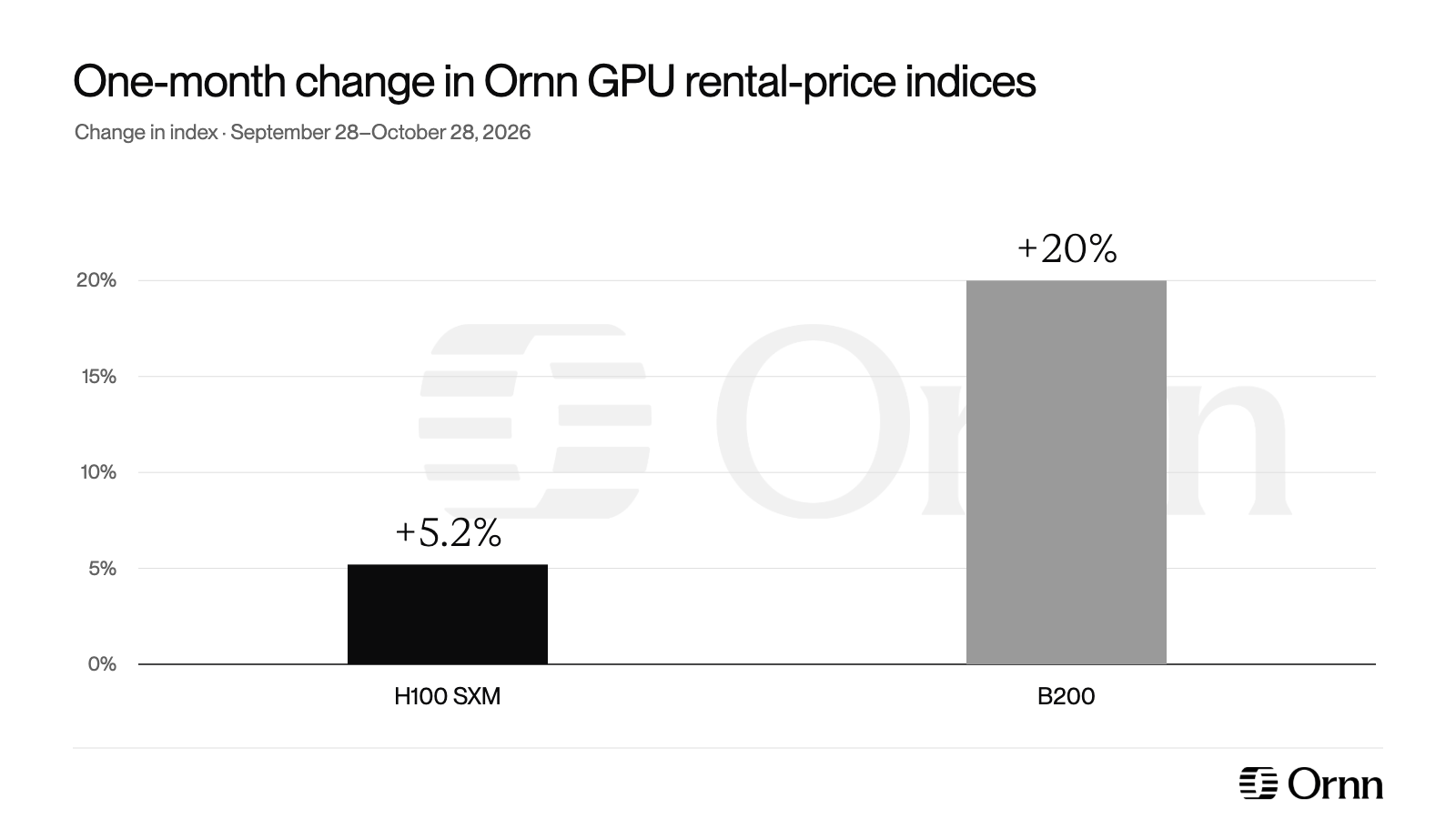
Source: Ornn H100 SXM and B200 rental-price indices, September 28 to October 28, 2026.
Research By: Ansh Krishna, Charlie Sheiner
GPU prices in this article
The latest Ornn Compute Price Index (OCPI): executed on-demand rental prices, per GPU-hour.
More research
- Utilization is King: The Buyer’s Side of Compute Certainty Tax
When a GPU reservation beats renting on demand, and why the timing of use matters as much as the amount.
- Introduction to Compute Markets #1: The Primary Market
How computing capacity is sold directly to customers: reserved, on-demand and spot.
- The Compute Certainty Tax
How much revenue GPU clouds give up to make their fleets financeable.