We’re launching Ornn’s Substack to explore the economics of AI infrastructure, from GPU pricing and financing to the emerging markets for compute.
Drawing on Ornn’s proprietary market data, we’ll publish original research and analysis on the entire AI stack, supported by our research staff. We hope you enjoy!
Anthropic’s S-1, released this morning, offers the most transparent account yet of the economics of the AI buildout. The company generated $16.3 billion in revenue in the first half of 2026, while committing hundreds of billions of dollars to future compute capacity.
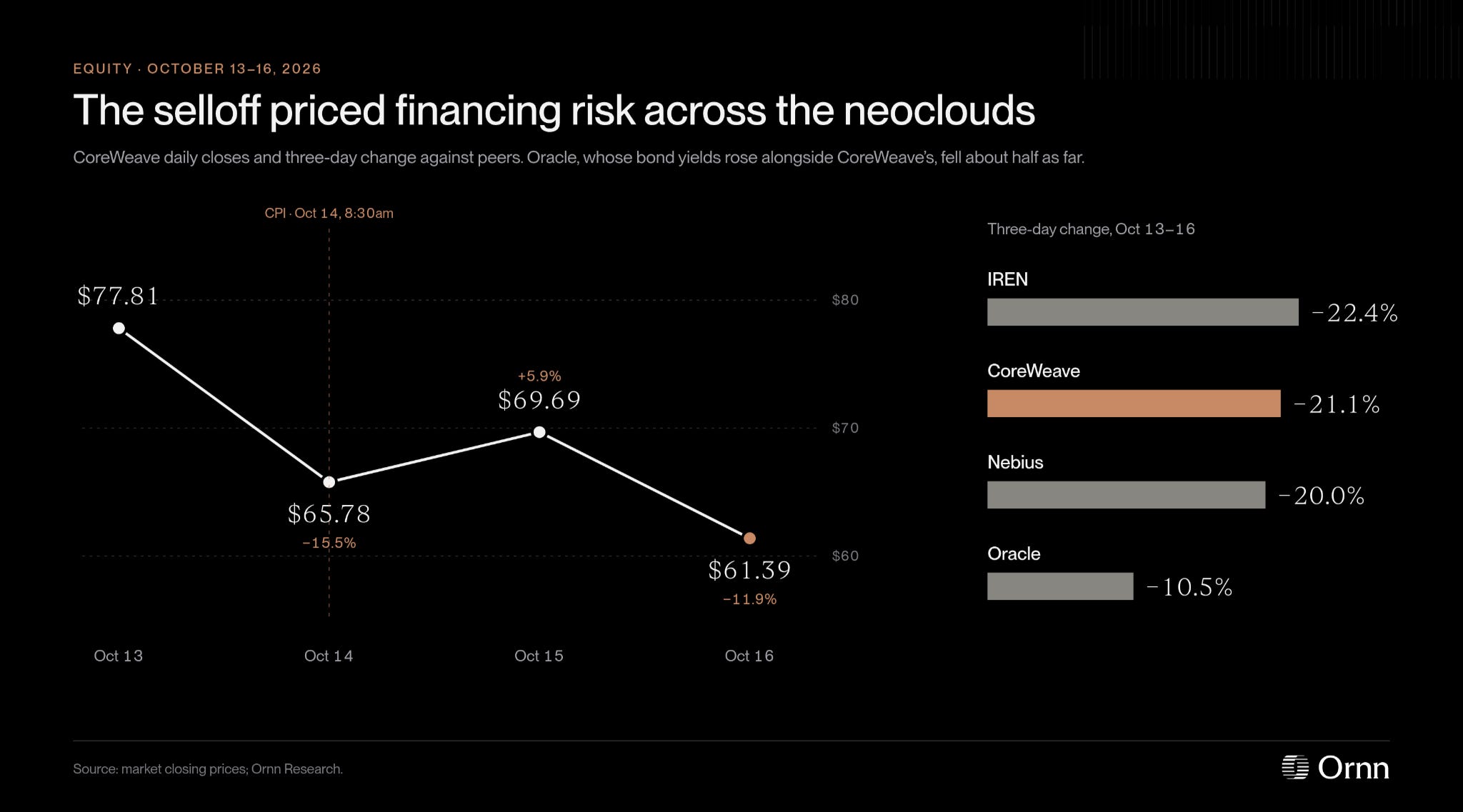
Among its infrastructure partners is CoreWeave, which finances much of its GPU buildout against long-term customer contracts. Just two weeks ago, CoreWeave shares fell 21.1%, accompanied by a sharp deterioration in its credit markets. The selloff occurred even as GPU rental prices remained strong, with Ornn’s B200 index climbing toward $8.50 per GPU-hour.
On its face, this seems contradictory. Anthropic’s extraordinary growth is driving demand for precisely the infrastructure CoreWeave is building, yet investors are increasingly concerned about CoreWeave’s creditworthiness. The distinction lies between securing future revenue and earning an adequate return on the infrastructure required to generate it. Long-term customer contracts can support substantial borrowing, but CoreWeave must still bring capacity online on schedule, service that debt, and recover sufficient value from its GPUs once those contracts expire.
CoreWeave’s selloff offers a useful case study in the infrastructure economics underpinning Anthropic’s growth, and the financial constraints of the AI buildout.
A levered-up balance sheet
CoreWeave’s thesis is relatively simple. It borrows to build GPU capacity that customers have already signed up to rent, and it expects those payments to cover the debt and leave a return.
Surging customer demand for compute capacity has underwritten its thesis. By the end of Q2 2026, CoreWeave had accumulated a $104 billion revenue backlog, supported by long-term, take-or-pay customer contracts. Under these agreements, customers commit to paying for reserved capacity regardless of how much they actually use. In the first weeks of Q3, CoreWeave secured another $25 billion in commitments while raising prices by approximately 25% across GPU types, contributing to an expected 5-10 percentage-point improvement in margins on these new contracts.
Meeting this demand requires enormous upfront investment, much of it financed through debt and leases against future contracted revenue. By the end of Q2 2026, CoreWeave carried approximately $35.1 billion in debt and $16.5 billion in lease liabilities, against just $5.0 billion in shareholder equity. That amounts to roughly $10 in debt and lease obligations for every dollar of book equity. For comparison, Alphabet, Microsoft, and Amazon carried approximately $0.20, $0.30, and $0.40, respectively, in debt and lease liabilities per dollar of book equity.
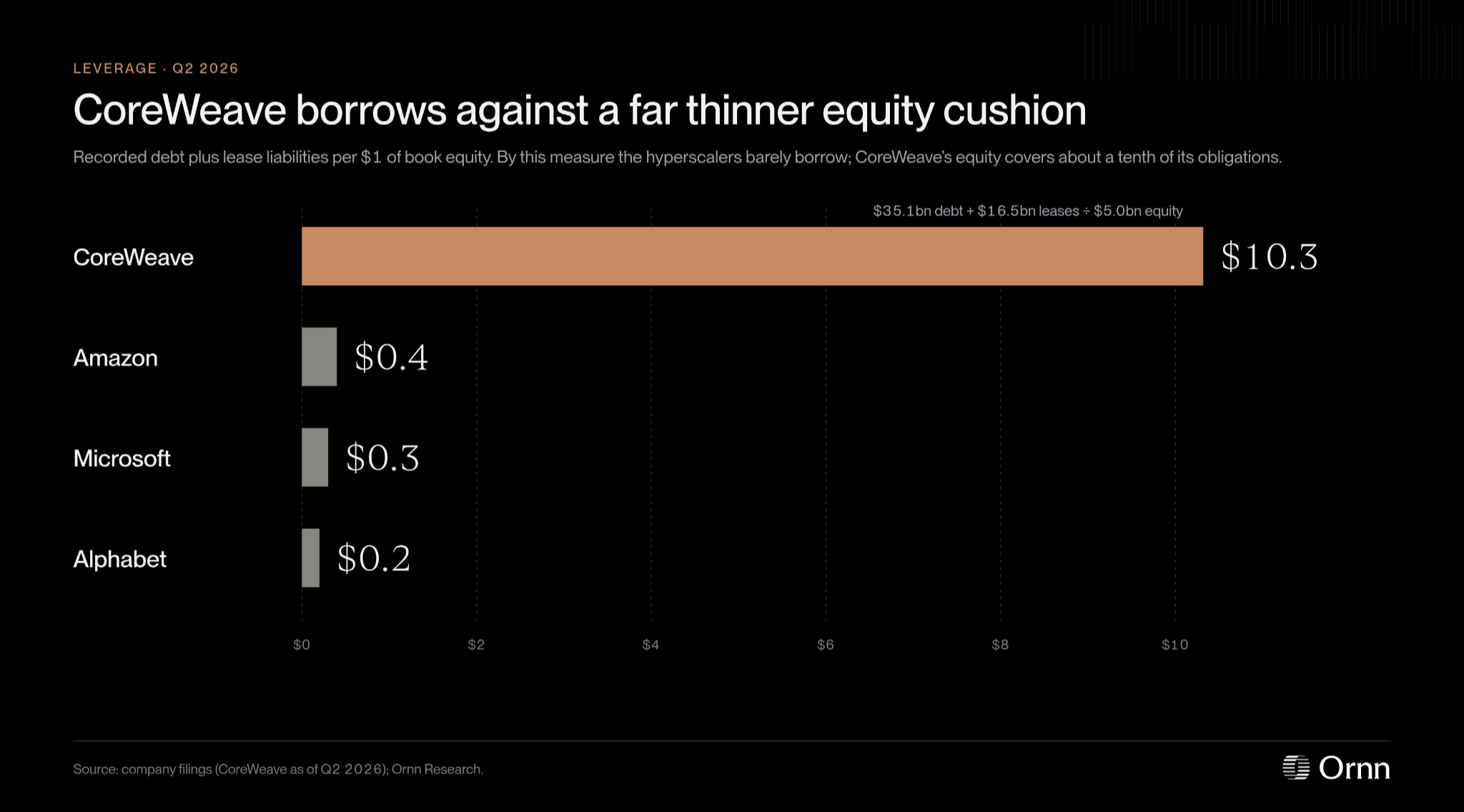
Since its Q2 filing, CoreWeave has disclosed another $6.6 billion in gross borrowings, including a $1.2 billion draw under its DDTL 5.5 facility, a reported $4.2 billion convertible-note issuance, and a further $1.2 billion drawn from its existing revolving credit facility.
Importantly, CoreWeave has been able to borrow at progressively lower rates even as its debt burden has grown. Its weighted-average interest rate fell from 12.2% in 2024 to 9.0% at the end of 2025 and 8.3% by June 2026. But cheaper borrowing has not translated into lower financing costs. The expansion of CoreWeave’s debt balance has more than offset the decline in its average interest rate, pushing total interest expense higher.
This distinction is central to understanding the business. CoreWeave has improved its ability to finance individual deployments while simultaneously taking on an increasingly large aggregate debt burden. The model can work very well when contracted revenue arrives on schedule and the equipment produces adequate returns. But the scale of borrowing leaves relatively little room for failure.
The model works if GPUs economics remain favorable
At first glance, CoreWeave’s underlying operating performance looks remarkably strong. In Q2 2026, the company reported a 59% adjusted EBITDA margin, reflecting substantial earnings potential before interest, depreciation, and other adjustments. Further down the income statement, however, that profitability narrowed considerably. CoreWeave generated $128 million in adjusted operating income against $640 million in net interest expense, ultimately reporting a $626 million net loss.
Some of this reflects a mismatch in timing. At the end of June, CoreWeave had $11.9 billion of capacity under construction that had not yet begun generating revenue. Financing costs accumulate as facilities are developed and equipment is purchased, while customer payments depend on the capacity becoming operational. As these facilities come online, the associated revenue should improve the picture.
To understand the remaining risks, it helps to examine the structure of CoreWeave’s financing.
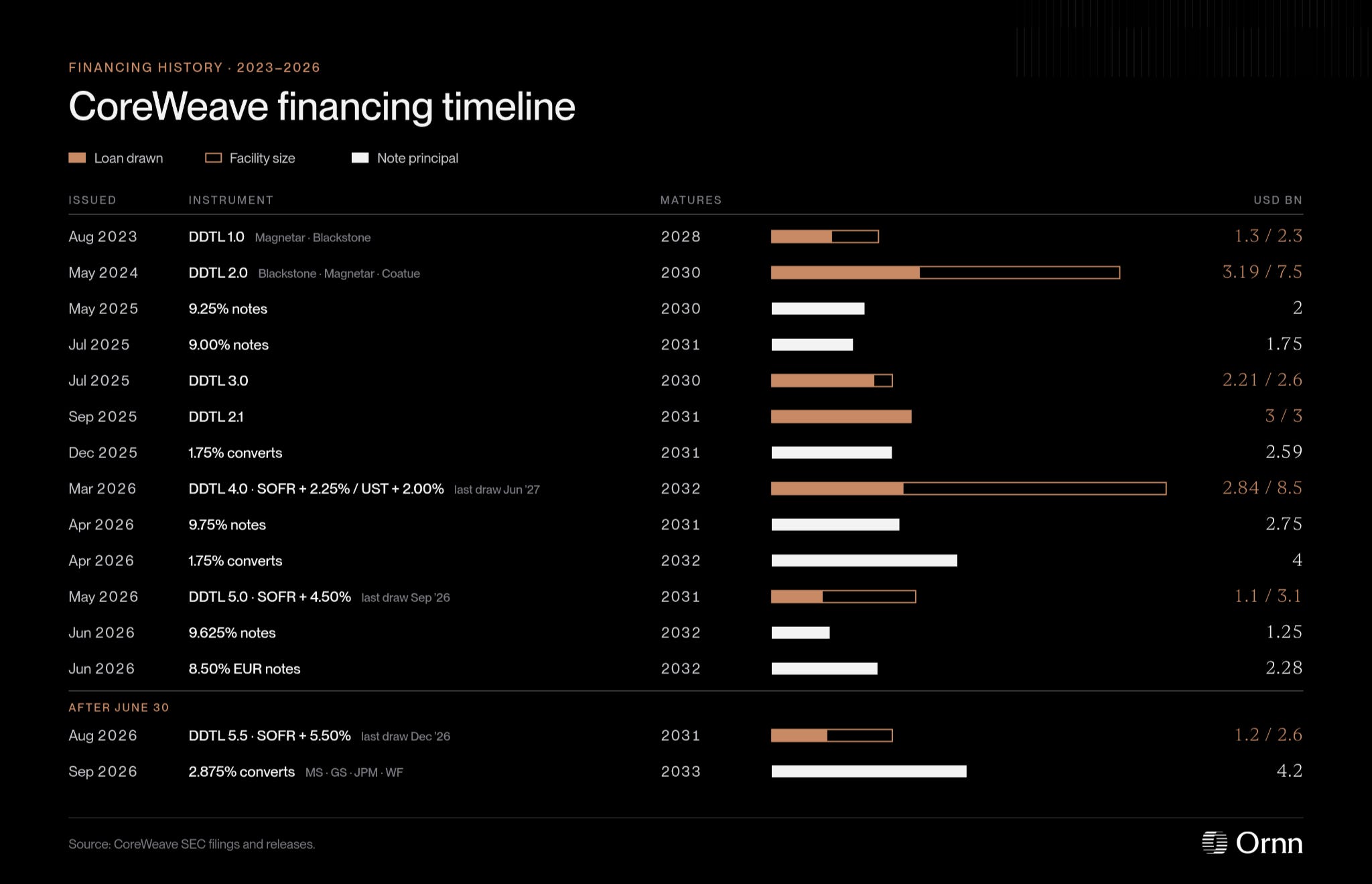
A substantial portion of the company’s borrowing consists of delayed-draw term loans (DDTLs), under which banks and private credit firms commit to lending up to a specified amount. CoreWeave draws these funds as it purchases equipment for contracted deployments, generally paying a floating rate based on SOFR (the U.S. short term benchmark interest rate) plus a contractual spread, although some facilities have fixed-rate components. Unlike a conventional bond that repays its principal at maturity, these loans are “amortizing debt”, meaning that CoreWeave pays back principal over time rather than all at once.
Practically, what this means is that CoreWeave faces substantial near-term cash requirements. As of Q2 2026, CoreWeave had $13.6 billion outstanding under DDTLs used to finance GPU servers and related equipment for contracted deployments. The company relies on cash from contracted GPU rentals to service that debt, making timely data center delivery critical.
Building data centers on schedule has become a major challenge. Local opposition blocked or delayed at least 75 U.S. data center projects worth approximately $130 billion in Q1 2026 alone. Interconnection queues, long lead times for electrical equipment, and construction bottlenecks add additional hurdles. Delays threaten to leave CoreWeave paying interest and scheduled principal before the customer receipts they depend on begin arriving.
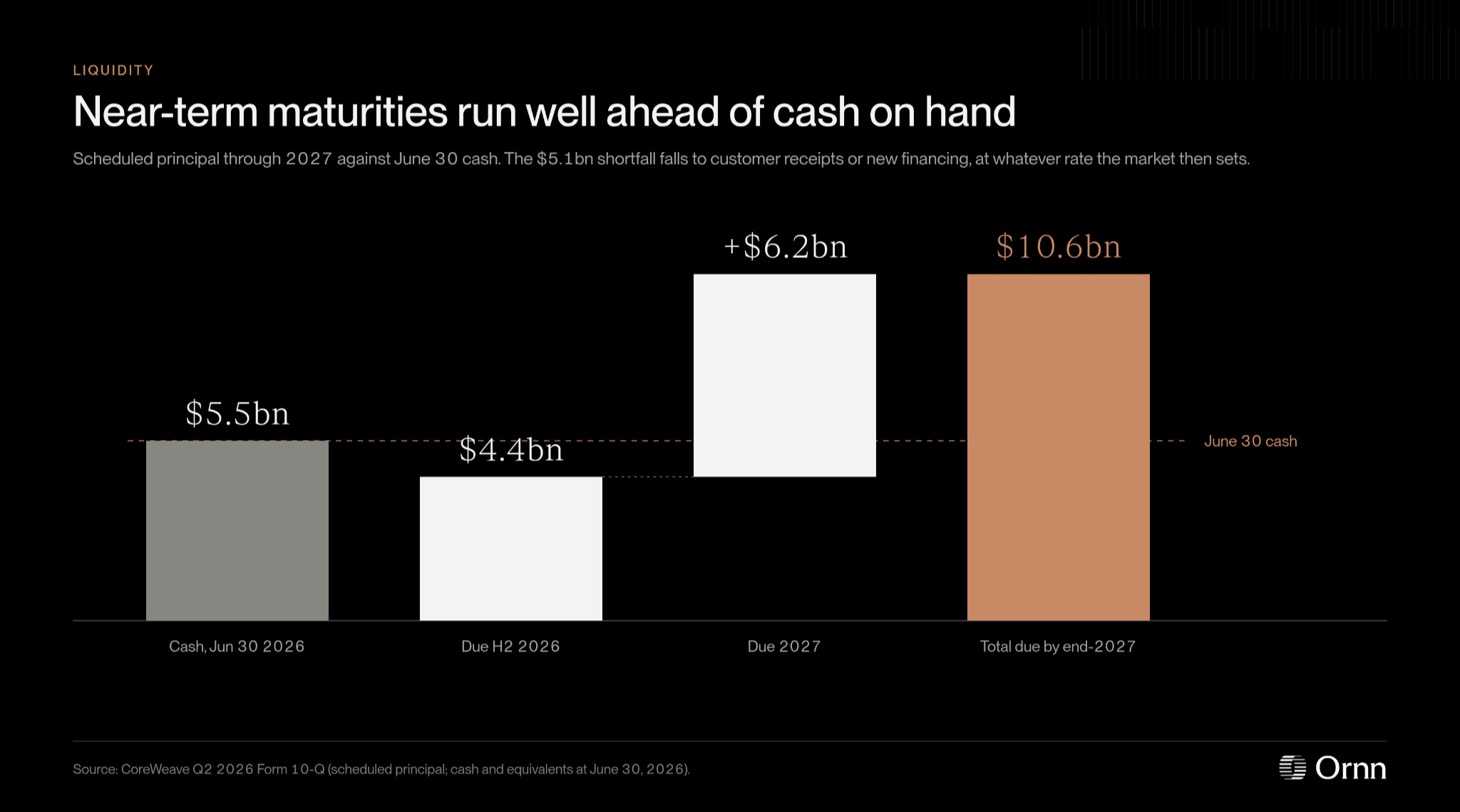
The repayment schedule adds to this pressure. According to its June 10-Q, CoreWeave had $4.4 billion in principal repayments due in the second half of 2026 and another $6.2 billion in 2027. That $10.6 billion in scheduled repayments exceeded its $5.5 billion cash balance at the end of June, leaving the company dependent on continued customer receipts and access to financing as it expands.
Yet the challenge is not simply whether CoreWeave can bring its existing projects online. Some of the financing depends on the GPUs remaining economically productive beyond their initial customer commitments, otherwise known as residual value.
In August, CoreWeave raised $2.6 billion through its DDTL 5.5 facility, priced at SOFR plus 5.50% and issued at approximately 96–97 cents on the dollar, producing an estimated all-in yield of 10.4%. The financing has a five-year maturity, while the contracts supporting it have an average duration of roughly three years. Although scheduled amortization reduces the amount outstanding over time, lenders are still exposed to the value and earning potential of the underlying GPU equipment beyond its initial contracted period.
This is where residual value becomes particularly important. During a take-or-pay contract, CoreWeave benefits from relatively predictable customer payments. Once that contract expires, the company must renew the customer, find another buyer for the capacity, or recover value from the equipment through another use or sale. Whether it can do so at attractive economics depends on the rental market for that generation of GPUs several years into the future.
There are reasonable grounds for optimism. CoreWeave depreciates its GPUs over six years, while Nebius uses four. Management has defended its assumption partly by pointing to a newly signed A100 agreement extending into 2029, on hardware originally released in 2020. Ornn’s research in The Economics of Open Weight Inference supports this thesis as well. Older GPUs can remain economically useful well after newer generations enter the market, particularly as inference workloads expand and models become more efficient.
However, continued usefulness is not equivalent to stable rental prices. A GPU can remain productive for six years while earning substantially less in its later years than it did when first deployed. Recent financing suggests that lenders are already differentiating between these risks. DDTL 5.5 priced at a spread one percentage point higher than the similarly rated DDTL 5.0 facility issued in May, which carried SOFR plus 4.50%. Differences in collateral, structure, market conditions, and expected future cash flows may all contribute to this spread. Still, the comparison is a reminder that CoreWeave’s declining historical average borrowing rate does not guarantee that each new deployment will become cheaper to finance.
Leverage magnifies the consequences of getting these assumptions wrong. CoreWeave reported approximately $31.4 billion of recourse debt, meaning the parent company had borrowed directly or guaranteed the relevant obligations, compared with approximately $3.7 billion of nonrecourse debt generally confined to specific borrowing entities. Around 90% of its recorded debt was therefore recourse, potentially exposing the broader business to shortfalls at individual deployments.
With roughly $77 billion in reported assets against $5 billion in book equity, a relatively small downturn in GPU prices could have a significant accounting effect on shareholders’ equity. That does not mean a comparable percentage decline in GPU rental rates would immediately produce such an impact, but it illustrates how much of the company’s financial structure depends on GPUs ultimately justifying their value over time.
An inflation surprise hits an already vulnerable borrower
By early October, investors were already demanding greater compensation for lending to CoreWeave. Between October 7 and 13, its five-year credit-default-swap (CDS) spread, which measures the cost of insuring against a borrower’s default, widened from 848 to 983 basis points, while its shares fell from $88.45 to $77.81.
Then, at 8:30 a.m. on October 14, a hotter-than-expected inflation report added to those concerns. September’s Consumer Price Index (CPI) rose 0.3% from August, above the 0.2% forecast. The surprise raised concerns that persistent inflation would leave the Federal Reserve less room to lower interest rates. The 10-year Treasury yield jumped from 5.19% to 5.26% immediately after the release, then climbed to 5.33% before 9 a.m., a 14-basis-point increase in less than half an hour.
CoreWeave’s securities reacted almost immediately. Within a minute of the CPI release, its shares fell from $74.78 to $72.81. By 9:30 a.m., the bid on its 2031 notes carrying a 9.75% coupon had fallen from 83.25 to 81.25 cents on the dollar. Yields on its unsecured notes subsequently approached 16%, while five-year CDS spreads reached 1,168 basis points that afternoon.
At that spread, insuring $10 million of CoreWeave debt would cost approximately $1.17 million annually. Assuming a 40% recovery rate, a simplified credit-pricing model implies a roughly 63% risk-neutral probability of default over five years.
These market prices matter because CoreWeave still needs substantial capital to complete its buildout. The coupons on its existing fixed-rate bonds do not change when their market yields rise, and secured financing backed by contracted deployments can price differently from unsecured parent-company debt. Nevertheless, unsecured yields approaching 16% signal more challenging conditions for future borrowing and eventual refinancing.
The divergence became more revealing as the week progressed. By October 16, the 10-year Treasury yield had fallen to 5.09%, below its October 13 level of 5.21%. Yet CoreWeave and Oracle bond yields remained elevated, while yields on bonds issued by Microsoft, Alphabet, and Amazon generally fell alongside Treasuries. The initial inflation shock had reversed, but the market continued to demand greater compensation to lend to CoreWeave. Investors, therefore, were also reassessing risks specific to its financing model, rather than simply reacting to Treasury yields.
The need for compute futures
The uncertainty surrounding CoreWeave’s future GPU revenues extends across the broader AI infrastructure industry. An estimated $5.2 trillion will be invested in AI data centers through 2030, and across these investments, lenders and operators face a common problem: determining whether the revenue generated by GPUs over their useful lives will justify the capital required to deploy them.
The answer depends, in large part, on what those GPUs will rent for in the future. It is an unusually difficult variable to forecast, because rental prices depend not only on broader demand for AI, but also on NVIDIA’s hardware releases, improvements in model efficiency, the economics of inference, the rate at which new compute capacity enters the market, and more. Even relatively small differences in these assumptions can substantially change the expected returns on a leveraged GPU deployment.
Today, there is no established, liquid forward market through which lenders can observe the market’s collective assessment of these future prices. Instead, assumptions about GPU depreciation, renewal rates, and residual values are negotiated largely between operators, customers, and financiers. CoreWeave’s DDTL 5.5, for instance, is supported by assumptions about what its equipment can earn after the contracted revenue expires. The uncertainty surrounding these assumptions ultimately undermine how much they are willing to lend, at what rate, and against which collateral.
A liquid futures market would change this in two important ways. First, it would provide transparent forward prices for specific generations of compute, allowing lenders and investors to evaluate expected GPU revenues against a publicly observable market benchmark rather than relying entirely on private projections. Second, it would allow market participants to transfer some of that price risk. A cloud provider expecting to have uncontracted GPU capacity in 2028 could sell futures to hedge against falling rental prices, while a customer expecting to purchase compute could take the other side to protect against rising costs. By reducing exposure to uncertain future rental rates, a well-designed hedge could also make the underlying infrastructure easier to finance.
Ornn is pioneering the development of this market, bringing Hopper H100 and Blackwell B200 futures to the Intercontinental Exchange (ICE). Settling against Ornn’s proprietary GPU rental-price indices, these contracts will establish a new way for investors, cloud providers, and customers to trade and hedge future compute prices, laying the foundation for a more transparent and sophisticated financial market for AI infrastructure.
As this market develops, Ornn Research will continue publishing data, analysis, and research on compute economics and infrastructure financing.
Follow us on X or get in touch to learn more.
GPU prices in this article
The latest Ornn Compute Price Index (OCPI): executed on-demand rental prices, per GPU-hour.
More research
- Utilization is King: The Buyer’s Side of Compute Certainty Tax
When a GPU reservation beats renting on demand, and why the timing of use matters as much as the amount.
- Will Anthropic Grow Into Its Compute Bill?
What Anthropic’s $895 billion in compute commitments imply about its growth trajectory.
- Introduction to Compute Markets #1: The Primary Market
How computing capacity is sold directly to customers: reserved, on-demand and spot.