NVIDIA crushed earnings expectations yesterday, reporting $115.8 billion in quarterly revenue, more than double a year earlier. The company’s growth further evidences the unstoppable demand for the chips Jensen Huang spent years building. Under his leadership, NVIDIA took on hundreds of billions of dollars in commitments to help its customers finance the data centers buying its chips. But with Jensen gone, will its new leadership share his conviction that demand will keep growing, and his willingness to put NVIDIA’s balance sheet behind it?
Ornn Research expects NVIDIA to continue financing strategically important customers but become far more selective about which risks it assumes and how much it demands in return. Backstops help customers secure the financing to buy its chips, so retreating from them also means putting sales at risk. Jensen accepted that trade because he believed compute demand would keep growing for years to come. His successors inherit both the exposure and a business that has benefited from his willingness to assume it.
Colette Kress, now interim CEO, reportedly opposed some of NVIDIA’s largest guarantees, including a proposed $250 billion commitment to OpenAI that was subsequently reduced to $105 billion. She has favored equity investments, which offer potential upside, over guarantees that could leave NVIDIA paying out billions if demand disappoints. Yet the attention paid to her financial background has obscured a more consequential question about how AGI-pilled she is. To someone who shares Jensen’s expectations for compute demand, a backstop can look like an inexpensive way to secure future chip sales; to someone less convinced, the same agreement leaves NVIDIA underwriting its customers’ optimism. To understand what is at stake, we need to examine why NVIDIA began making these commitments, how the economics work, and how much risk it has taken on.
The financing problem
To understand why NVIDIA began guaranteeing its customers’ obligations, we first need to understand how those customers finance their GPUs.
Neoclouds need enormous amounts of capital to build data centers, but lenders are reluctant to finance projects without predictable cash flows. Selling compute on demand makes that difficult. To secure financing, neoclouds have therefore had to sell much of their future capacity through long-term fixed-rate contracts, often at steep discounts to on-demand prices. These contracts provide lenders with greater revenue certainty, but limit how much neoclouds can earn from their GPUs.
Even with these commitments in place, their borrowing costs remain substantially higher than those of established technology companies. Alphabet sold 50-year bonds at 5.7% in November, while CoreWeave borrowed $2.6 billion in July at almost twice that rate. NVIDIA’s backstops are an attempt to relieve these constraints. By assuming risks that would otherwise fall on lenders and infrastructure investors, NVIDIA can help neoclouds obtain financing on more favorable terms. In doing so, it supports demand for its own GPUs, but takes on financial risks that would otherwise remain with its customers and their financiers. The extent of that risk depends on how NVIDIA structures its commitments and the circumstances under which it is required to pay.
What NVIDIA is doing
NVIDIA has extended five types of support to its customers. Here is a quick rundown.
Lease guarantees
First, NVIDIA guarantees a customer’s lease obligations if it defaults. At OpenAI’s Ohio data center, for instance, NVIDIA has agreed to cover shortfalls of up to $105 billion if OpenAI fails to pay. The guarantee gives SB Energy, the landlord, greater assurance that it will be paid, allowing OpenAI to secure infrastructure it might otherwise struggle to finance.
Direct leases
NVIDIA also signs data center leases itself, then makes the capacity available to customers. At Hut 8’s Texas campus, for example, NVIDIA signed a 15-year lease for facilities that Lambda will use to serve Anthropic. Hut 8 gets a creditworthy tenant, Lambda gets infrastructure, and NVIDIA secures demand for its chips. Unlike a guarantee, NVIDIA owes the rent whether or not its customer pays. Its latest filing disclosed $74 billion in future data center leases.
Capacity backstops
Here, NVIDIA agrees to rent unused GPU capacity from neoclouds at a fixed price. If customers rent the capacity at higher rates, NVIDIA buys nothing and may receive a share of revenue. If demand falls short, NVIDIA becomes the buyer of last resort.
This guarantees neoclouds a minimum revenue stream, making financing easier while allowing them to sell more capacity on demand. NVIDIA, in turn, assumes the risk of falling compute prices and utilization. The WSJ reported in August that some arrangements had been paused, which NVIDIA disputed.
Residual value support
NVIDIA has proposed guaranteeing a portion of the residual value of GPUs purchased by financing vehicles. This protects lenders against hardware depreciation, making GPU purchases easier to finance, but leaves NVIDIA exposed if its chips lose value faster than expected. The proposed agreements remain nonbinding.
Equity stakes
NVIDIA also invests directly in customers, including $2 billion in CoreWeave and a proposed multibillion-dollar investment in OpenAI. Unlike guarantees, equity investments give NVIDIA ownership and potential upside, while generally limiting losses to the amount invested. Kress has reportedly been more supportive of equity investments than guarantees.
The economics behind NVIDIA’s betIn effect, NVIDIA is selling puts on compute demand. It earns substantial profits selling GPUs today while assuming some of the risk that those GPUs will generate less revenue than expected in the future. With gross margins of roughly 75%, guarantees that unlock additional chip sales could be worthwhile even if some eventually result in losses. Whether the trade makes financial sense depends on how much additional profit NVIDIA generates relative to the risks it assumes.
For now, conditions in the compute market have made these backstops exceptionally favorable. Despite the introduction of newer and more powerful chips, the H100 rental price has risen 74% over the past year and stands 7% above its level in mid-2024. Older hardware has retained its earning power considerably better than rapid improvements in GPU performance might suggest.
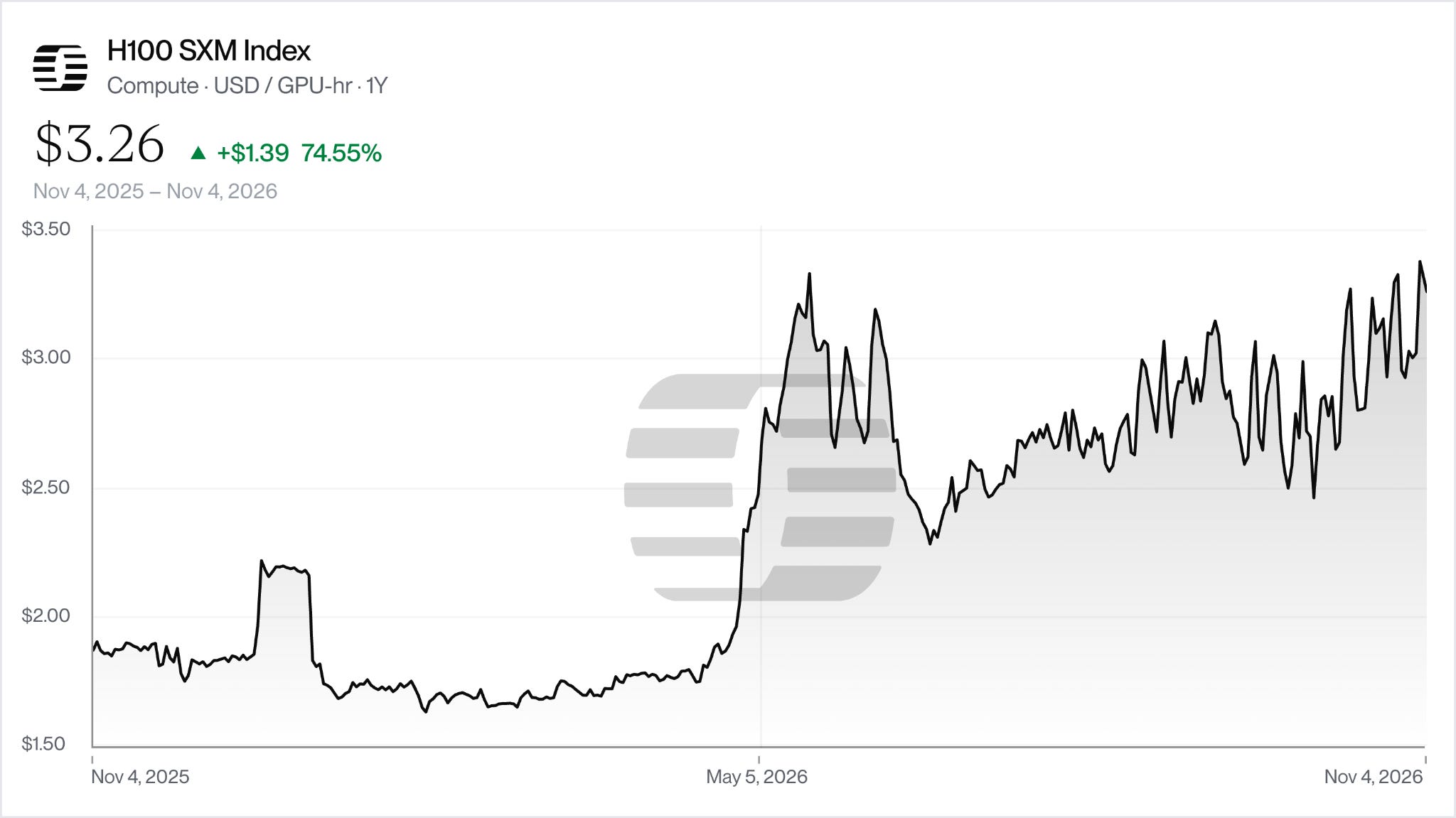
Figure 1: H100 rental price (USD per GPU-hour), past year. Source: Ornn
Newer GPUs have also seen strong demand. B200 utilization has risen from below 20% in late 2025 to approximately 96% today, indicating that providers are finding customers for nearly all their available capacity.
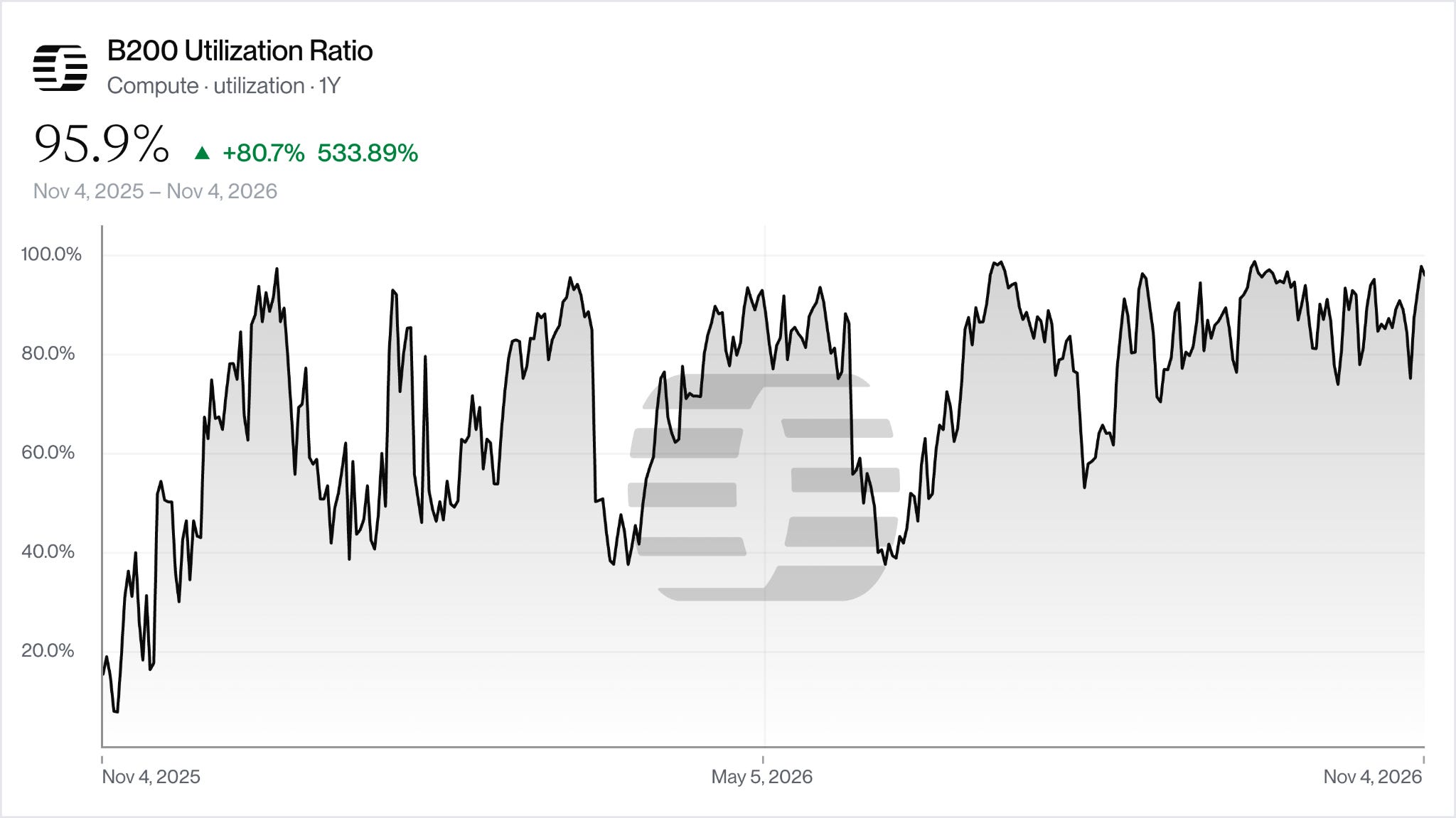
Figure 2: B200 utilization, past year. Source: Ornn
The economics are extraordinary. At current rental rates and utilization, a B200 can generate enough revenue to cover its entire hardware purchase price in just nine months, despite being depreciated over four to six years. Every other GPU tracked by Ornn reaches the same threshold within 20 months. These figures exclude operating and financing costs, but illustrate just how profitable GPU rentals can be at prevailing prices, and why NVIDIA has been willing to underwrite the expansion of its customers.
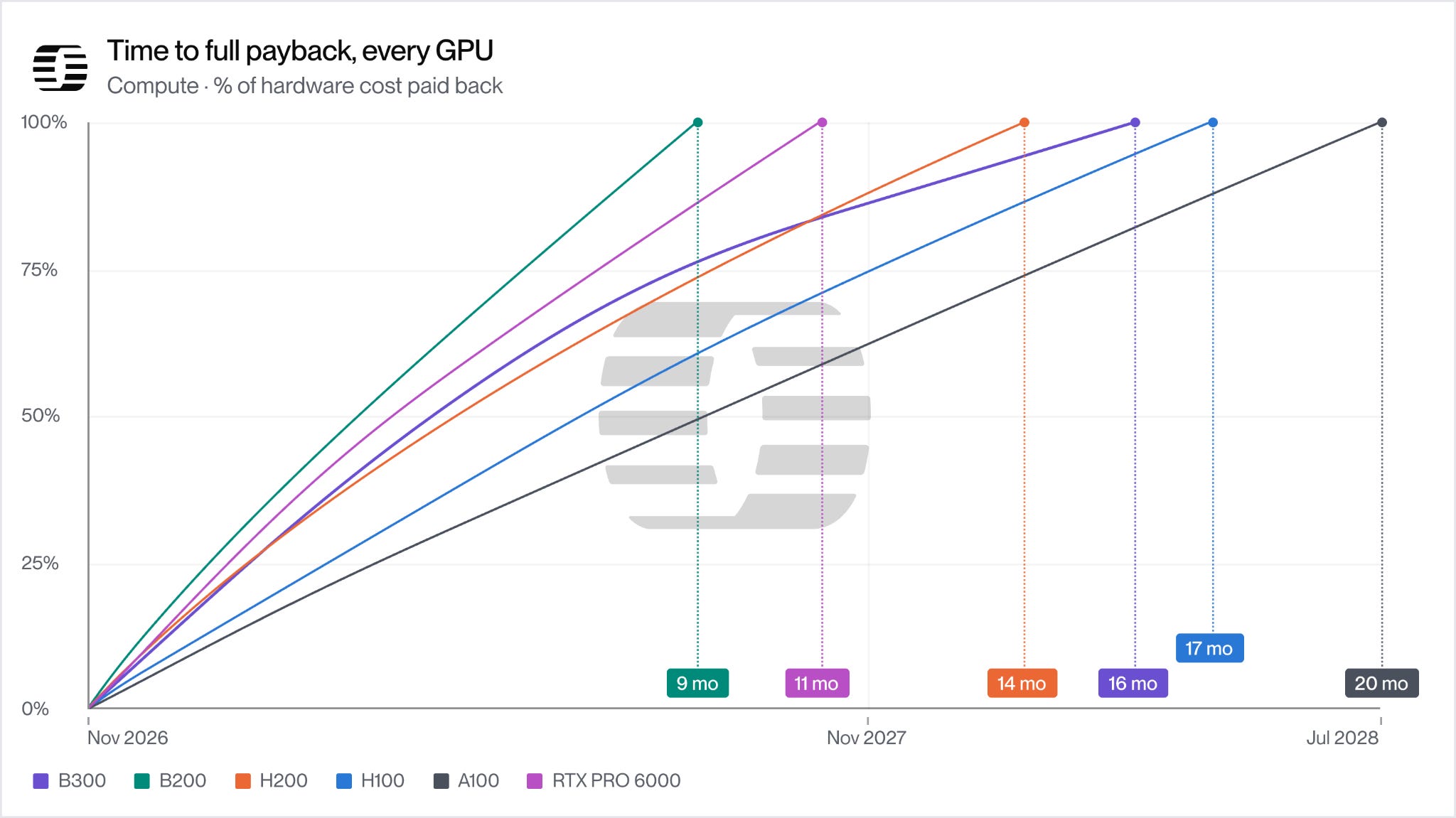
Figure 3: Time to full payback by GPU, from November 2026. Source: Ornn
Yet these are precisely the conditions that make NVIDIA’s guarantees relatively inexpensive. If rental prices fall or utilization declines, neoclouds could struggle to generate sufficient revenue, and NVIDIA could find itself paying for capacity that customers no longer want. Falling hardware values could also expose it to losses on residual value guarantees, while financial distress among its customers could trigger lease guarantees. These risks are correlated: a downturn in compute demand would make NVIDIA’s commitments more expensive at the same time as it reduced demand for new chips.
Nvidia’s potential exposure is enormous. In earnings, the company disclosed $118 billion in maximum exposure under signed guarantees, including $105 billion supporting OpenAI’s Ohio data center, $9.5 billion in power and systems guarantees, and $3.5 billion in other neocloud guarantees. It also reported $32 billion in neocloud capacity purchase commitments, down from $36 billion last quarter. The distinction matters as lease guarantees generally require customers to default before NVIDIA must pay, while capacity commitments can become payable simply because demand falls short. Separately, NVIDIA disclosed $74 billion in future data center leases, although these primarily support its own infrastructure needs and some may eventually be assigned to third parties.
These are gross contractual obligations, not expected losses, so NVIDIA can recover some value through the capacity and lease rights and cover the rest with its substantial cash reserves. The company is therefore in a far better position to absorb these risks than the neoclouds and lenders that would otherwise bear them. However, its capacity to absorb losses does not necessarily mean that taking on additional commitments is the best use of its balance sheet.
NVIDIA without JensenJensen’s departure is unlikely to bring NVIDIA’s financial support for its customers to an end, but it will fundamentally change the terms on which that support is offered. Kress has given mixed signals about her willingness to continue these arrangements. As CFO, she oversaw the financing that made them possible, and on NVIDIA’s August earnings call defended its equity investments against accusations of circular financing. Privately, however, she reportedly opposed some of the company’s largest guarantees, including the proposed $250 billion OpenAI commitment. According to the Wall Street Journal, the disagreement became sufficiently contentious that Jensen called her a “deer in headlights” and a “reporting CFO.”
Her apparent preference for equity indicates NVIDIA will continue to participate in the upside if its customers succeed, while generally limiting its exposure to the capital invested. Guarantees are different, as NVIDIA earns additional gross profit from the GPU sales they enable, but can remain exposed to substantial liabilities years after those chips have been sold. Kress is likely to be willing to finance the same customers as Jensen while demanding considerably more favorable terms for doing so.
Importantly, NVIDIA had reportedly begun tightening its backstop arrangements before Jensen’s departure. The Wall Street Journal reported in August that some capacity agreements had been paused, which NVIDIA disputed, while its proposed $500 billion financing partnership with Wall Street had reportedly struggled to produce transactions. His removal may therefore accelerate a shift already underway rather than initiate an entirely new strategy. Ornn Research expects NVIDIA to continue supporting strategically important customers, but to become substantially more selective about the guarantees it provides.
The consequences extend beyond NVIDIA’s balance sheet. As SemiAnalysis put it, “Neoclouds around the world raised their money because Jensen backed them, not because they compared chips and chose Nvidia.” NVIDIA’s willingness to assume risks that lenders would not has allowed projects to secure financing on terms that might otherwise have been unavailable. If that support becomes harder to obtain, neoclouds may have to accept higher borrowing costs, commit more capacity through discounted long-term contracts, or reduce their expansion plans.
Perhaps the greatest irony of NVIDIA’s potential shift away from guarantees is its timing. Compute remains supply-constrained, rental prices are exceptionally high, utilization is near capacity, and some GPUs can generate revenue equivalent to their purchase price in less than a year. These are unusually favorable conditions for underwriting additional capacity, yet NVIDIA may become less willing to provide the guarantees that help finance it. If its new leadership is reluctant to assume these risks when the economics look this strong, the terms of neocloud financing could become considerably more restrictive long before demand for compute begins to weaken.
GPU prices in this article
The latest Ornn Compute Price Index (OCPI): executed on-demand rental prices, per GPU-hour.
More research
- Utilization is King: The Buyer’s Side of Compute Certainty Tax
When a GPU reservation beats renting on demand, and why the timing of use matters as much as the amount.
- Will Anthropic Grow Into Its Compute Bill?
What Anthropic’s $895 billion in compute commitments imply about its growth trajectory.
- Introduction to Compute Markets #1: The Primary Market
How computing capacity is sold directly to customers: reserved, on-demand and spot.